
Full Circle
On healing, responsibility, and living what we learn

Artwork, unknown artist.
An 8-10 reflective read
This piece is written for readers willing to move slowly and reflect on the intersections of experience, knowledge, and moral responsibility.
When the phoenix rises, the work of integration begins. Such is the spiral path of transformation: a deepening of understanding, a greater coherence at new altitudes.
In recent months, I have experienced several distinct spiritual or mystical moments that seem to form an emerging pattern. I hope to write about one of these in the future. For now, I turn my attention to a different kind of experience: coming full circle.
“Coming full circle” is not unusual in itself; many people have experienced it—that moment when something from the past, whether a person, an experience, a learning, or an intuition, returns. These moments are nostalgic, and they are orienting, offering confirmation and opening the door to deeper association and understanding.
In the past few years, I have had two such full-circle moments: one with Anello & Hernandez’s Transformative Leadership (which I hope to write about one day), and one with clinical psychologist Patricia Romano McGraw’s book It’s Not Your Fault: How Healing Relationships Change Your Brain and Help You Overcome a Painful Past—which also connected to a groundbreaking scientific discovery by Allan Schore about the single most important element for healthy human development from infancy onward: warm, emotionally attuned, and trusting relationships.
This full-circle experience represents the convergence of lived healing, intuition, and scientific truth.
With this clarity comes responsibility. In my very first classroom as a young teacher, a banner hung boldly above the front of the room: “Welcome to the World of Responsibility!” Meant for children (and parents) then, it was a lifelong call for their vision—and now, echoed in Anello & Hernandez’s Transformative Leadership, it underscores a principle central to their framework: the moral responsibility to investigate truth and apply it wisely, serving humanity’s well-being and its peace and security.

Healing Relationships and the Science of Attunement
Years ago, during a period of conscious healing, I was accompanied by a woman whose presence profoundly altered the course of my life—Maggie Lindeman (scroll to end). She was deeply sensitive and spiritual, yet practical and intellectually grounded, approaching truth through both science and faith. Over time, we came to see that we had been placed in each other’s path to learn collaboratively—through insight and analysis, and love, care, and true and trusted friendship. What I then experienced as love and lived spiritual wisdom, I would later recognize as something science now clearly describes: the human brain heals and organizes itself in relationship.
Research in affective neuroscience, particularly the work of Allan Schore, has shown that emotionally attuned relationships shape the right hemisphere of the brain—the seat of emotional regulation, resilience, and relational capacity. This is evolutionarily significant. Long before words or reasoning, the nervous system learns emotional safety, trust, and coherence through presence. What has been known intuitively by mothers, caregivers, educators, and highly sensitive persons is now supported by rigorous scientific inquiry.
As Schore summarizes decades of research on emotional relationships, from infancy throughout the lifespan:
An interpersonal neurobiology of human development enables us to understand that the structure and function of the mind and brain are shaped by experiences, especially those involving emotional relationships…
—Right Brain Psychotherapy (2019), p. 2.
Full Circle: When Intuition Meets Science
When Maggie and I first met and walked a shared path of healing and learning, I gave her It’s Not Your Fault by Patricia Romano McGraw before I had read it myself. We were both excited and struck by its powerful truth: healing does not arise primarily from technique or analysis, but from emotionally safe, trusting relationships.
Maggie embodied this truth. She was deeply spiritual, highly sensitive, and grounded in moral clarity. What made her extraordinary was not what she did, but how she was—truthful, loving, kind, nonjudgmental, trustworthy, and present. Our healing work drew on both Cognitive Behavioral Therapy and the Baha’i Writings, yet it was the relationship itself that made transformation possible.
A few months later, when I finally read the book myself, it named what I had lived: that loving kindness, emotional attunement, and emotional safety can literally reorganize the brain. The research grounding this truth came from Allan Schore, whose work I have been unknowingly living for years.
Fast forward to now: a friend sent me a link to an Association for Baha’i Studies reading group on Schore’s Right Brain Psychotherapy. I felt immediate recognition but could not place it at first. Where had I encountered this name before? When the book arrived the next day, memory clicked—this was the science underlying my healing all along.
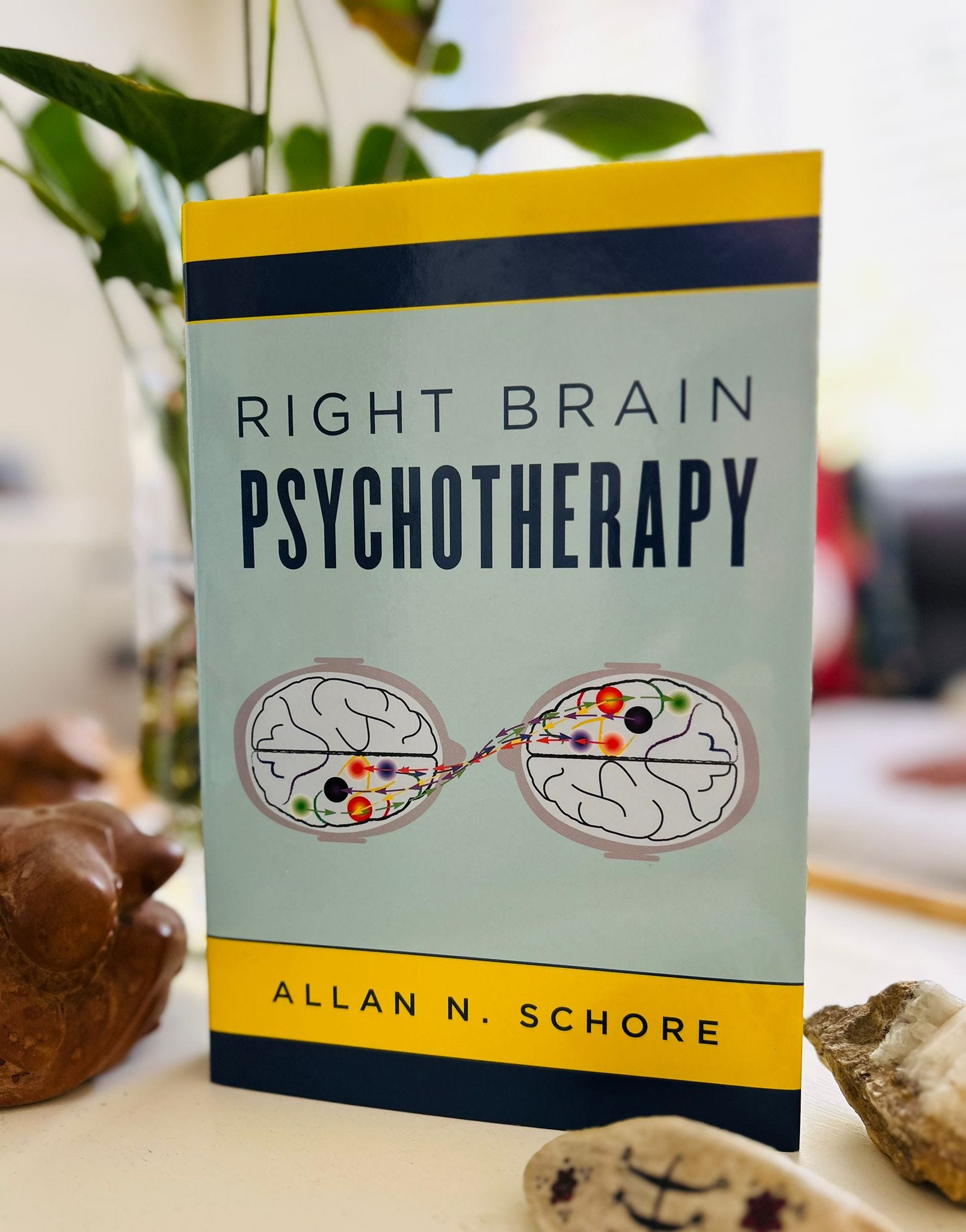
Wow—my heart leapt as I realized the full circle.
From It’s Not Your Fault: How Healing Relationships Change Your Brain and Can Help You Overcome a Painful Past (2004):
I heard the neuroscientist Dr. Allan Schore talk about changes in a newborn baby’s brain that occur as a result of the relationship between the mother and the baby! Aha! At last, I found the missing piece—scientific evidence that relationships change your brain! The beginning of scientific proof that niceness, shall we say, does different things to your insides than blame or shame. Here was scientific proof that violence [and neglect and the like] hurts the body and the mind and the beginning of an explanation of why therapy [and all manner of relationship] that is warm, caring, and empathetic makes a difference—a physical difference—that is real and potentially long lasting.
—McGraw, p. 9.
Moral Responsibility as Application
This insight brought me full circle—to the science and, more importantly, to the deeper responsibility that comes with knowing these truths.
All men have been created to carry forward an ever-advancing civilization.
—Baha’u’llah, Gleanings, CIX.
Transformative Leadership articulates a principle that feels especially relevant in this moment: the moral responsibility to investigate and apply truth. Responsibility, in this sense, is stewardship. We are called to carry forward what we have learned—experientially, relationally, spiritually, individually and collectively.
Here I am, in 2026, beginning formal counseling training. What is it that is my defining understanding? It has become unmistakably clear: healing happens in true relationship—not through force, not through insight alone, and not in isolation, but through emotionally regulated, morally grounded, loving presence sustained over time. Everything else, every method and framework, grows from this center.
For me, this is what it feels like to come full circle: to be entrusted with a deeper responsibility for a truth first known through ‘‘intuitive knowledge’’—“pure bounty,” then returned through “conceptual knowledge.” The science now gives language to what the soul-body already understood.
Part of the mystery of life: Some truths we live before we fully understand them, and over time they guide us toward the life we are called to live.
Knowledge is of two kinds: existential knowledge and formal knowledge, that is, intuitive knowledge and conceptual knowledge.
The knowledge that people generally have of things consists in conceptualization and observation; that is, either the object is conceived through the rational faculty, or through its observation a form is produced in the mirror of the heart. The scope of this knowledge is quite limited, as it is conditioned upon acquisition and attainment.
The other kind of knowledge, however, which is existential or intuitive knowledge, is like man’s knowledge and awareness of his own self.
For example, the mind and the spirit of man are aware of all his states and conditions, of all the parts and members of his body, and of all his physical sensations, as well as of his spiritual powers, perceptions, and conditions. This is an existential knowledge through which man realizes his own condition. He both senses and comprehends it, for the spirit encompasses the body and is aware of its sensations and powers. This knowledge is not the result of effort and acquisition: It is an existential matter; it is pure bounty.
—’Abdu’l-Baha’, Some Answered Questions, Chapter 40.

Closing: The Gift of What Returns
Like the phoenix, we rise through cycles of learning, loss, and renewal. What we first encounter in lived experience—through trust, care, and true relationship—returns to us with illumination and awakening, calling us to act with greater wisdom and love. Each insight, each thread of understanding is entrusted not for keeping, but for continued learning and for guiding others in their growth—whether as educators, counsellors, or companions on the path of human development—while nurturing the self in light of the oneness of humanity and our shared responsibility to contribute to the flourishing of all.
With appreciation for your presence.
Take your time with these reflections. May they settle, return, and deepen in your heart and mind. Revisit them if you like, allowing whatever insights, trust, and wisdom they bring to weave themselves into your own journey.
“Regard man as a mine rich in gems of inestimable value. Education can, alone, cause it to reveal its treasures, and enable mankind to benefit therefrom.” —Baha’u’llah